Web Design
10 Signs Your Website Is Costing You Customers
Learn how to recognize website issues that may be weakening trust, reducing inquiries, or losing sales—and when a redesign may be worth considering.
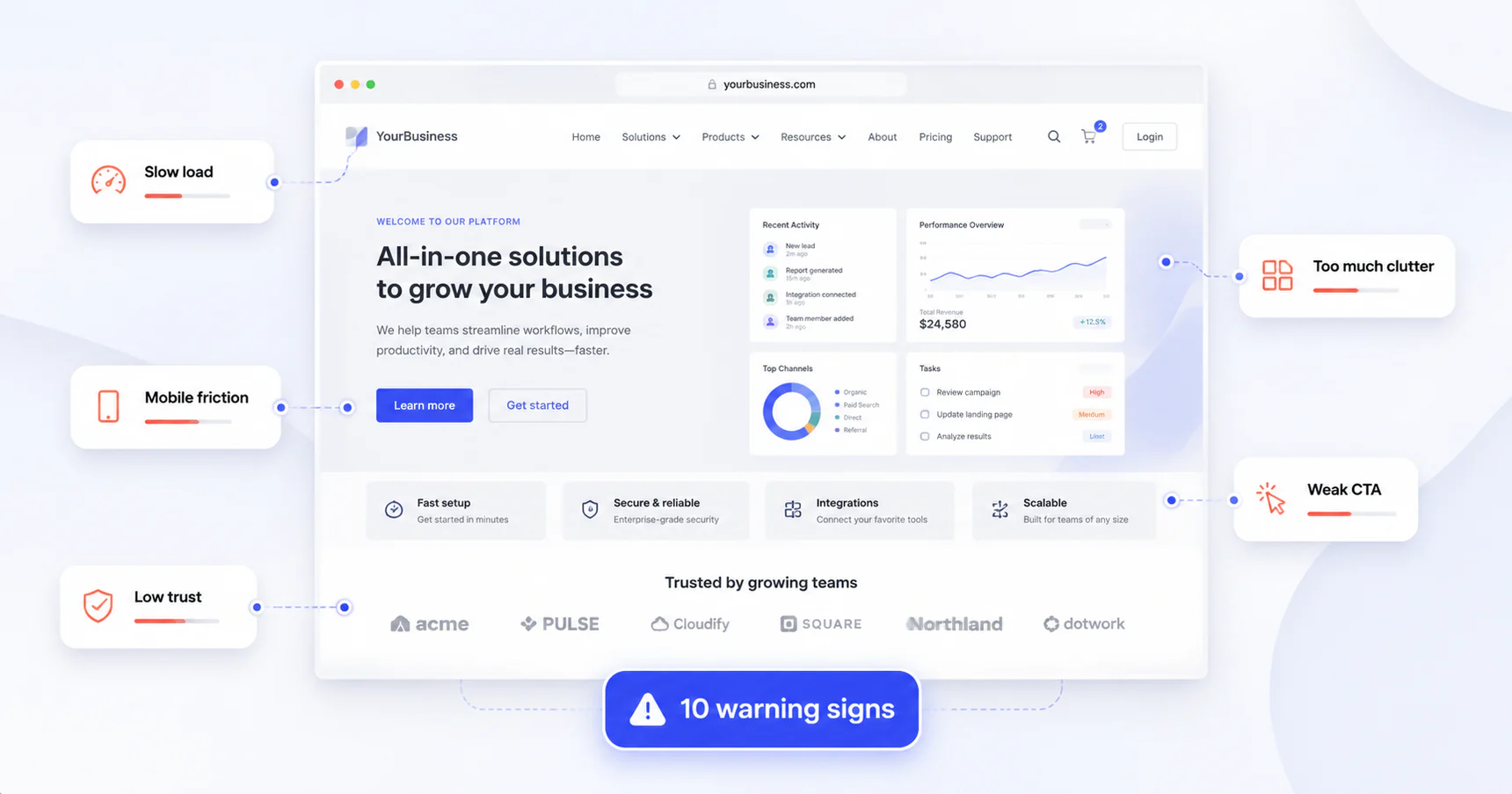
Your website is supposed to be your hardest-working employee — open 24/7, making the case for your business before a prospect ever picks up the phone. But an outdated website doesn't just sit there quietly underperforming. It actively pushes people away, often without you realizing it's happening.
If you've had a nagging feeling that your site isn't pulling its weight, here are 10 signs your website needs a redesign — and what to do about it.
1. It Looks Outdated
Visitors form an opinion about your business within seconds of landing on your site, and most of that judgment is visual. Dated fonts, clip-art-style graphics, cramped layouts, or a design that screams “early 2010s” all signal one thing to a visitor: if the website hasn't been updated, maybe the business hasn't either. That's a tough first impression to recover from, especially against competitors with a more current look.
2. It's Not Mobile-Friendly
More than half of web traffic now comes from phones. If your site requires pinching, zooming, or sideways scrolling to read on a mobile screen, you're frustrating the majority of the people who land on it. Google also factors mobile usability into search rankings, so a clunky mobile experience can hurt you twice — once with visitors, and once with your visibility in search results.
3. It Loads Too Slowly
Every extra second of load time increases the odds that a visitor bounces before the page even finishes loading. A slow site is one of the most common — and most fixable — website conversion problems out there. It's often caused by bloated images, outdated code, or a hosting setup that hasn't kept pace with the site's content.
4. Visitors Don't Know What to Do Next
Take a hard look at your homepage. Is it obvious what action you want a visitor to take — book a call, request a quote, make a purchase? If there's no clear call to action, or there are too many competing ones, people will leave without doing anything at all. A confused visitor doesn't convert; they close the tab.
5. The Navigation Is Confusing
If someone has to hunt for basic information — your services, your pricing, your contact details — they'll often give up and go to a competitor instead. Confusing menus, buried pages, and inconsistent labeling are classic business website mistakes that quietly chip away at your conversion rate.
6. Your Branding Feels Inconsistent
Mismatched fonts, colors that don't match your logo, or a tone that swings from formal to casual page to page all undermine trust. A website should feel like a cohesive extension of your brand, not a patchwork of decisions made at different points over the years.
7. It Doesn't Reflect What You Actually Do Now
Businesses evolve — services get added, dropped, or repositioned — but websites often don't keep up. If your site is still describing a version of your business from three years ago, you're either confusing potential customers or losing the work you're best positioned to win today.
8. There's No Social Proof
Testimonials, case studies, client logos, reviews — these are some of the most persuasive elements on a website, and a surprising number of sites leave them out entirely. Without proof that real people have had a good experience with you, visitors are left to take your word for it, and most won't.
9. It's Not Built to Rank
An outdated website is often an under-optimized one. Missing page titles, no meta descriptions, slow load times, and a lack of fresh content all make it harder for search engines to find and rank your site. If you're invisible in search results, it doesn't matter how good the website looks once someone finally lands on it.
10. You're Embarrassed to Share the Link
This one is more gut check than checklist item: if you hesitate before sending someone to your website, that hesitation is telling you something. Your site should be something you're proud to put in front of a prospective client, not something you quietly hope they don't look at too closely.
When to Redesign a Website
You don't need to check every box above to justify a redesign. As a general rule, it's time to consider one if:
- It's been more than 3–4 years since your last redesign
- You've noticed a drop in inquiries, leads, or sales tied to your site
- Your business has changed significantly since the site was built
- You're consistently fielding the same confused questions from prospects that your website should be answering
A website redesign isn't just a cosmetic refresh — done well, it directly addresses the conversion problems above and turns your site back into an asset instead of a liability.
Ready to Fix What's Costing You Customers?
At Fractionl Studio, we specialize in redesigning websites for small and growing businesses — combining clean, modern design with development that actually performs. If any of the signs above sound familiar, it's worth a conversation.
Check out our services to see how we can help
Or get in touch to talk through what a redesign could look like for your business.
Frequently Asked Questions
How do I know if my website needs a redesign?
Common signs include an outdated look, slow load times, poor mobile experience, confusing navigation, no clear calls to action, and a drop in leads or inquiries coming from your site.
How often should a business website be redesigned?
Most businesses should consider a redesign every 3 to 4 years, or sooner if the business itself has changed significantly or the site is underperforming.
Can a bad website really cost me customers?
Yes. A slow, outdated, or confusing website increases bounce rates and reduces conversions, meaning visitors leave before taking any action like contacting you or making a purchase.
When should I hire a web designer?
It's time to hire a web designer when your current site no longer reflects your business, isn't generating leads, looks outdated compared to competitors, or performs poorly on mobile devices.
Work with Fractionl
Ready to move the work forward?
Tell us what you are building, improving, or trying to solve.