
Web Design
Web Designer vs. Web Developer: Which One Does Your Business Need?
This article compares the responsibilities of web designers and web developers to help businesses decide whether they need one role or both.
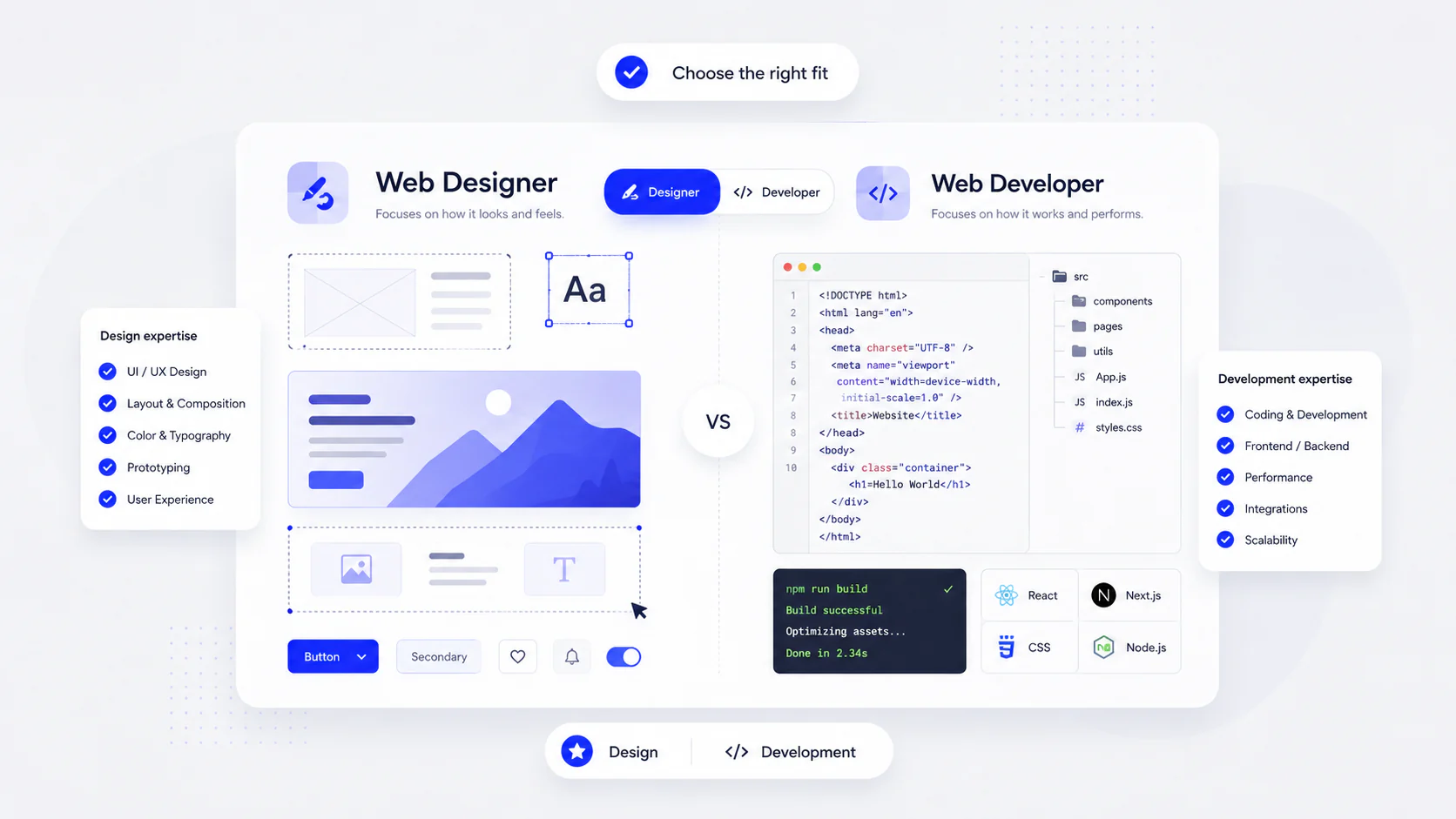
If you've started looking for help with your website, you've probably run into this fork in the road pretty quickly: do you hire a web designer, a web developer, or both? The terms get thrown around so interchangeably that it's easy to assume they're the same job. They're not — and hiring the wrong one (or only half of what you need) is one of the most common reasons small business website projects stall out or end up costing more than planned.
Here's a clear breakdown of the difference between a web designer and a web developer, plus how to figure out which one your business actually needs.
What Does a Web Designer Do?
A web designer is responsible for how your website looks, feels, and flows. Think of them as the person shaping the experience: layout, color, typography, imagery, and the overall visual identity of your site. A good designer is also thinking about usability — how a visitor moves from your homepage to a contact form, what draws the eye first, whether your site actually reflects your brand or just looks like a template with your logo dropped in.
Common Things a Web Designer Handles
- Visual branding and layout for your site
- Wireframes and mockups before anything gets built
- User experience (UX) — making sure the site is easy and intuitive to navigate
- Choosing fonts, colors, and imagery that match your brand
- Designing for mobile and desktop
What a designer typically does not do: write the code that makes the site actually function. A designer can hand you a beautiful mockup, but someone still has to build it.
What Does a Web Developer Do?
A web developer takes that design (or a set of requirements) and builds the actual, functioning website. This is the technical side — the code, the structure, the systems running behind the scenes. Developers make sure your site works correctly across browsers and devices, loads quickly, and can handle whatever functionality your business needs, whether that's a contact form, an online store, a booking system, or a CRM integration.
Common Things a Web Developer Handles
- Writing the front-end and back-end code
- Making sure the site is responsive and functions properly
- Integrating tools like CRMs, payment systems, or booking platforms
- Site speed, security, and technical performance
- Ongoing maintenance and updates after launch
A developer can technically build a site without a designer's input, but the result often looks exactly like what you'd expect from a programmer designing in a vacuum: functional, but not built with your brand or your customer's experience in mind.
Website Designer vs. Developer: The Short Version
| Comparison | Web Designer | Web Developer |
|---|---|---|
| Focus | Look, feel, and user experience | Code, function, and technical build |
| Tools | Figma, Adobe XD, design systems | HTML/CSS, JavaScript, CMS platforms |
| Output | Mockups, wireframes, visual direction | A working, live website |
| Good at | Branding, layout, usability | Functionality, integrations, performance |
Neither role replaces the other. A designer without a developer can't launch a site. A developer without a designer can launch one — just not one that necessarily looks like your brand or converts visitors into customers.
So, Do You Need a Web Designer or a Developer?
It depends on where you're starting from and what the project actually requires.
You Probably Need a Designer First If:
- You have a developer or dev team already, but no clear visual direction
- Your current site works fine technically but doesn't reflect your brand
- You're starting from scratch and need someone to map out the experience before any code gets written
You Probably Need a Developer If:
- You already have designs or brand guidelines and just need them built
- Your site needs specific functionality — a CRM, a booking system, an online store
- Your current site has technical issues (slow load times, broken forms, mobile bugs) but looks fine
You Need Both If:
- You're building a new site from the ground up
- You're rebranding and need the new identity carried through a fully functioning site
- You want a site that looks professional and works reliably, without managing two separate freelancers and hoping their work lines up
That last scenario is where most small businesses actually land. It's also where things get complicated if you hire a designer and developer separately — handoffs get messy, timelines stretch, and nobody's fully accountable for the end result if something looks off or breaks.
Website Design and Development, Handled as One Process
This is the gap a full-service studio is built to close. Instead of hiring a designer to create a vision and then crossing your fingers that a separate developer can execute it faithfully, design and development happen as one connected process, with one team accountable for the outcome from first mockup to live site.
At Fractionl Studio, that's exactly how we work — design and development under one roof, so your site doesn't just look right, it works right too. If you're trying to figure out which one your project needs, take a look at our services or reach out and we can help you figure out where to start.
Explore Fractionl Studio services
Frequently Asked Questions
What is the difference between a web designer and a web developer?
A web designer focuses on the look, layout, and user experience of a website. A web developer writes the code that makes the design actually function as a live, working site.
Do I need a web designer or a web developer for my small business website?
Most small businesses need both. A designer shapes how the site looks and feels; a developer builds it so it works correctly across devices and handles any functionality you need, like forms, bookings, or e-commerce.
Can a web developer also do web design?
Some developers have design skills, but design and development are different disciplines. For a polished, brand-aligned result, it's usually better to have a dedicated designer involved, even if one person or team handles both roles.
Is it cheaper to hire one person who does both design and development?
Often, yes. Hiring a single studio or freelancer who handles both reduces handoff issues, miscommunication, and the risk of paying twice to fix mismatched work between separate designers and developers.
How do I know if my website problem is a design issue or a development issue?
If your site looks outdated, confusing, or off-brand, that's a design issue. If it's slow, broken, not mobile-friendly, or missing functionality, that's a development issue. Many small business sites have both, which is why a combined design-and-development approach is often the most efficient fix.
Work with Fractionl
Ready to move the work forward?
Tell us what you are building, improving, or trying to solve.